
Spring 2026
managers’ message

Please note the new park hours as 9:00 am-5:00 pm Thursday-Monday. Closed on Tuesday and Wednesday.
Wow!, we have had a busy last few months. The Barnacle has been filled with both progress and community-centered activities.
I will start with the elephant in the room, as it were, The Pavilion, visitors to the park may have noticed, won't be completed by March 18th as I mentioned in our last newsletter. Between City permits and contractor issues we have been delayed. The new completion date is unknown at this time. However I can tell you that when this project is done we will have a very nice, beautiful Pavilion. We appreciate your patience and will keep you updated as progress continues.
This quarter also included Washington Birthday Regatta. As this was my first, I must say I now know why it has become such a cherished tradition. Seeing the community connect with The Barnacle’s maritime heritage in such a way that we bring our history to life is nothing short of Amazing!
Thank you to all the great volunteers that helped make this event possible. Thank you all for your continued support, and thank you for making The Barnacle a wonderful place to visit.
Daniel Kelsey, Park Manager
President’s Message

Greetings Barnacle family & friends!
Please join us on March 28th for our annual meeting on the lawn. This complimentary reception is for members and their guests. Board Members, Ashley Castillo and Walt Walkington have worked tirelessly to create this “Spritz By The Sea” for our membership. We will have a small silent auction, plenty of light bites and music to enhance the experience.
We will introduce our three new board members and are delighted to welcome each of them with their deep roots in our community. Bryn Ingram, Doug Reno, and Wirth Munroe have agreed to serve and we are most grateful. Each brings knowledge and talent to our already outstanding group of volunteer Board Members. Please look for their profiles in our upcoming newsletters!
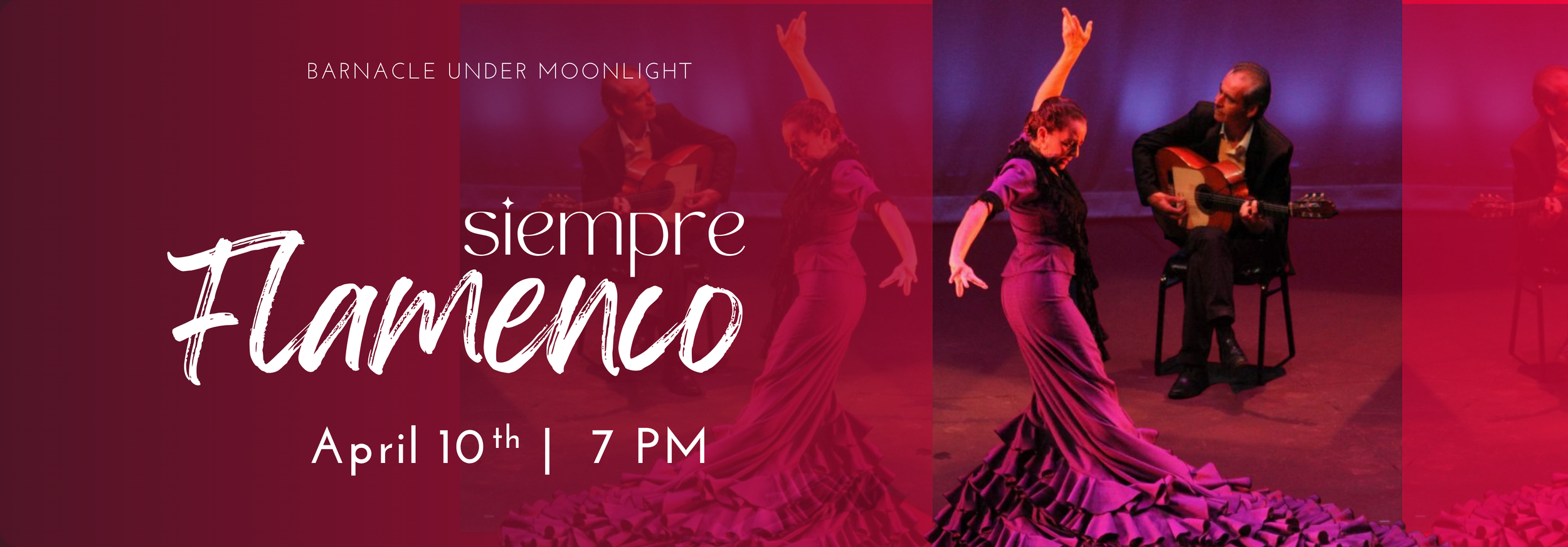
Please join us for our next moonlight concert and dance performance of the season on April 10th. Siempre Flamenco’s Paco and Celia Fonta present an authentic flamenco show dedicated to preserving the art of flamenco in a fresh, engaging and high energy performance. Gates open at 6 and live entertainment is from 7-9. It is a perfect way to wind down from the week, pack a picnic or grab your favorite take-out, and come throw a blanket on the lawn! You are welcome to bring your favorite beverages too just remember that you must take all your trash and recyclables with you when you leave. We are working on a great line up for next season which will begin in September 2026.
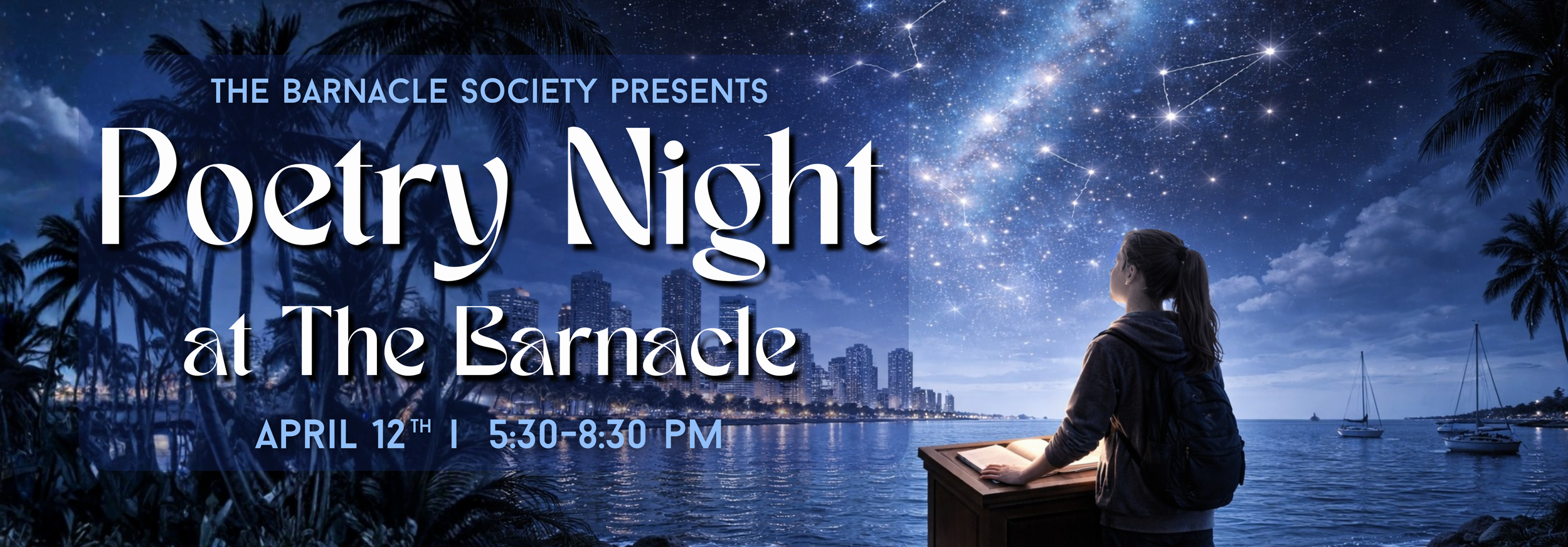
On April 12th, you won’t want to miss our 3rd Annual Poetry Night at the Barnacle from 5:30 to 8:30. This event is the brainchild of Board Member Marc Stone, and is considered by many to be Miami’s premier event during National Poetry Month. Marc has collected 350 poems from students at our community high schools and there are many notable guests, admission is complimentary with an rsvp and light refreshments will be served.
Construction on our pavilion continues and we appreciate your patience while we work around this process. Thank you for supporting our efforts, we do it for you and couldn’t do it without you. See you soon!
Mary Scott Russell, President, The Barnacle Society
The Barnacle welcomes our new museum Registrar
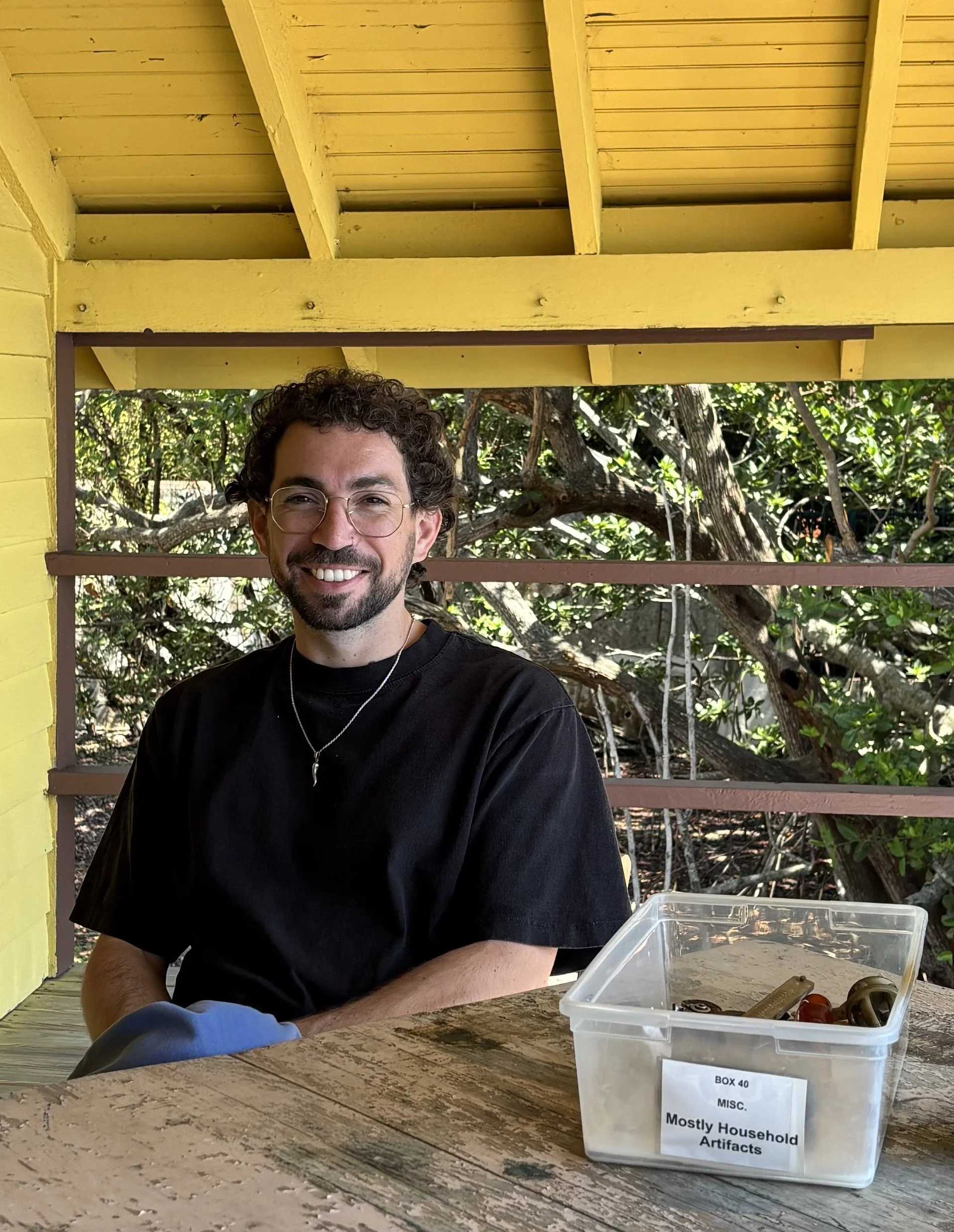
You may have noticed a new face at the Park, a nattily dressed young man delving into the collections of things in the historic buildings in the park. Vincent Nastasi is our new Museum Registrar and is busy putting things in order! He spent his first few weeks sorting out the second floor of the boathouse, cataloging important artifacts and confirming their provenance. More recently, he has spent a lot of time in the library, cleaning up and sorting holdings there.
(left) Vinny Nastasi with a few of a large collection of artifacts
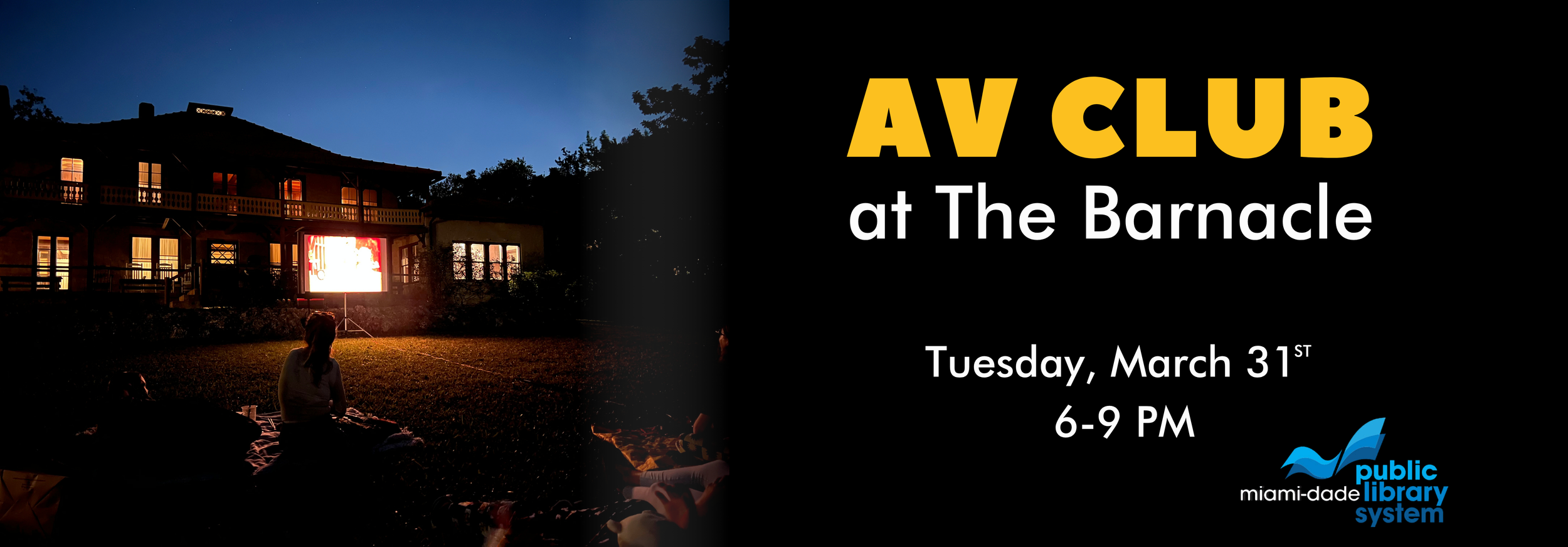
Vincent went to Miami-Dade College and Florida International University with a concentration in Art History. He has a strong interest in history, and has forged many connections for the Barnacle, including the Land Trust, History Miami, and the Women’s Club of Coconut Grove. He has hosted meetings of the South Florida Archivists Collective at the Park and started the A-V Club at the Barnacle (open to the public), where classic and historic films are shown. He also gives tours at The Barnacle and can do so in both Italian and English.
Welcome Vinny, and thanks for bringing your talents to the Barnacle Historic State Park!
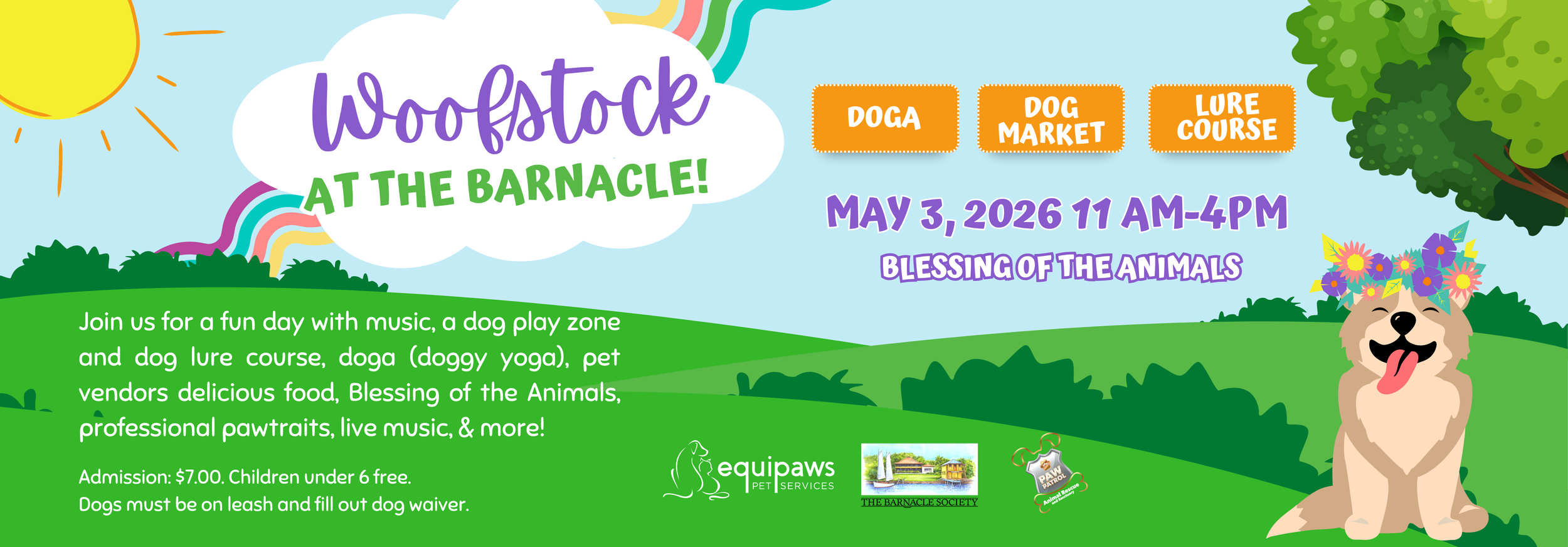
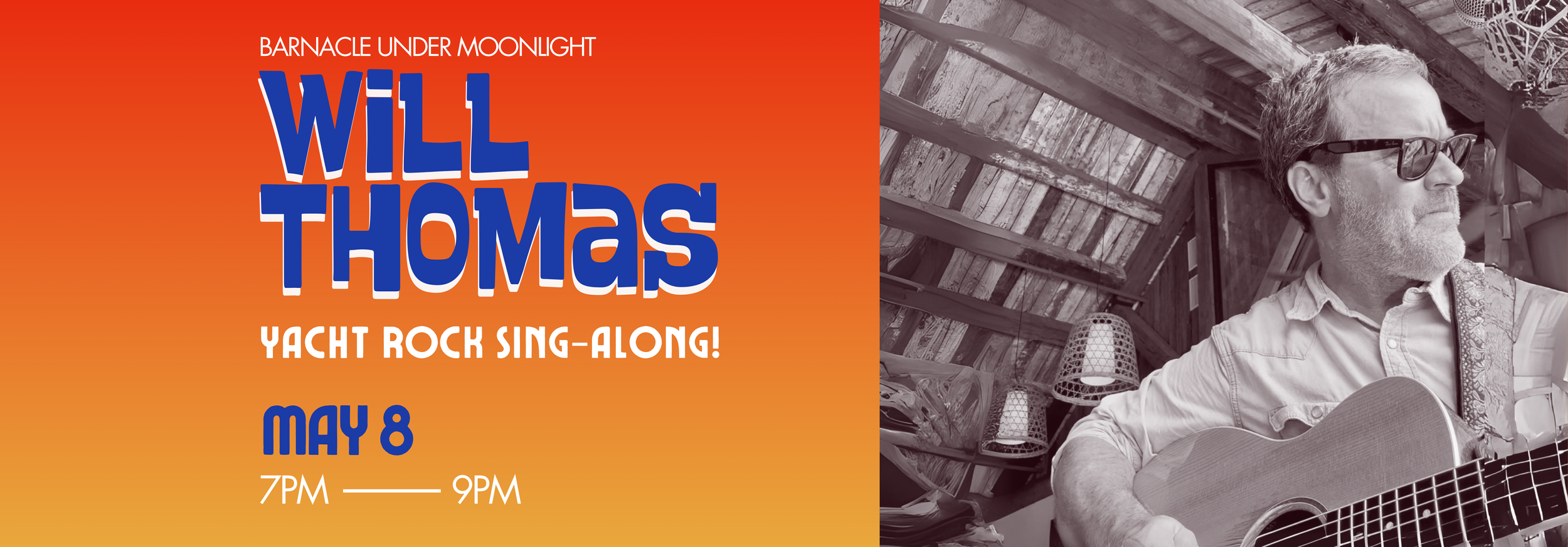
UPCOMING EVENTS AT THE BARNACLE
Junior Rangers report
Kevin Floyd, Park Service Specialist
Every Friday, I meet with the Junior Rangers from Grove Academy here in Coconut Grove. During our sessions at the Barnacle, we explore a variety of topics through hands-on activities. Each month, we focus on four core areas: Cultural Resources, Natural Resources, Recreation, and Service. These themes form the foundation of the Junior Ranger experience.
The program has been very well received, and I’ve gotten positive feedback from both the students’ teacher and the school principal. The kids are especially enjoying the interactive, hands-on approach.
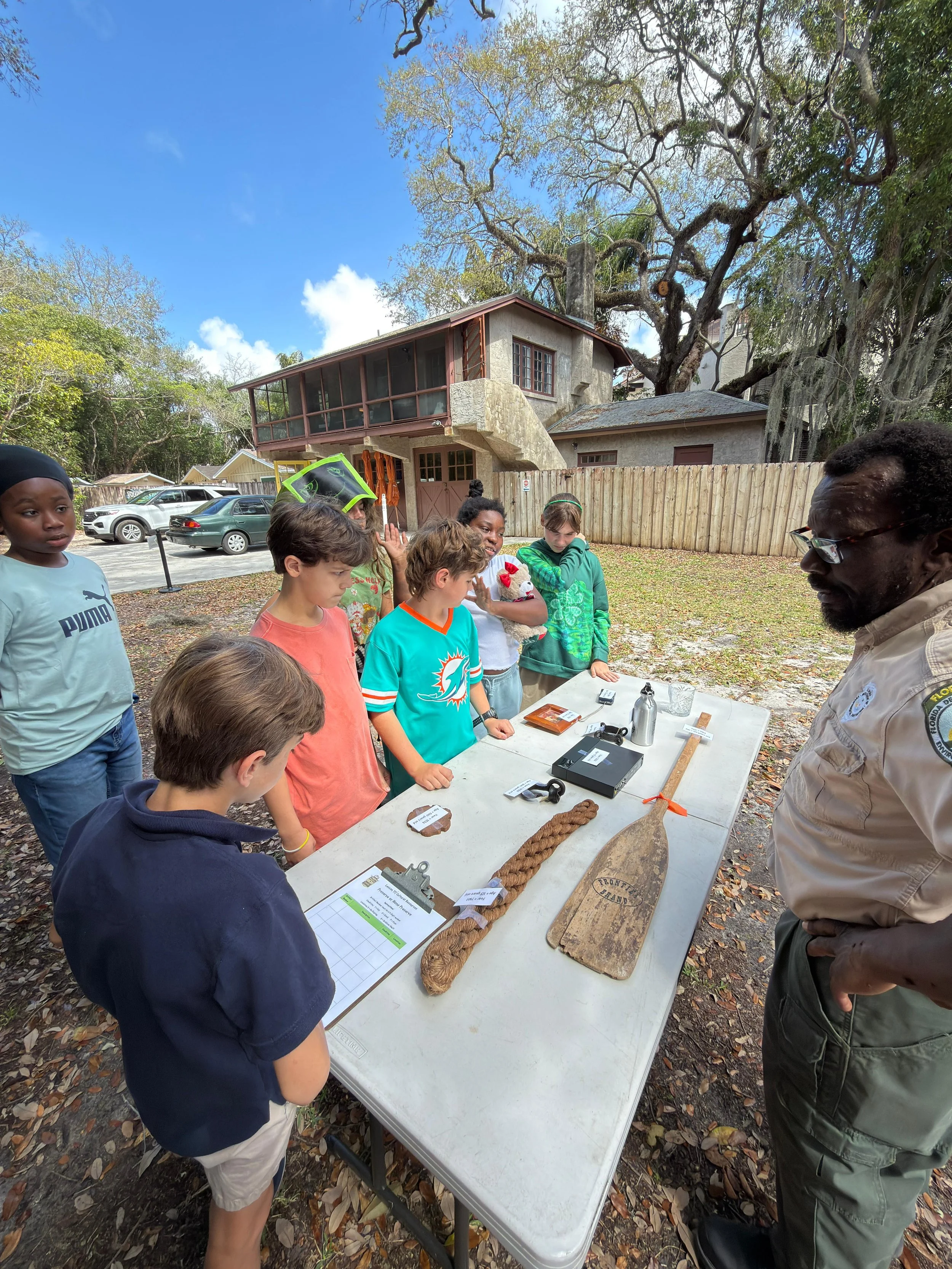
An array of artifacts for discussion with Junior Rangers
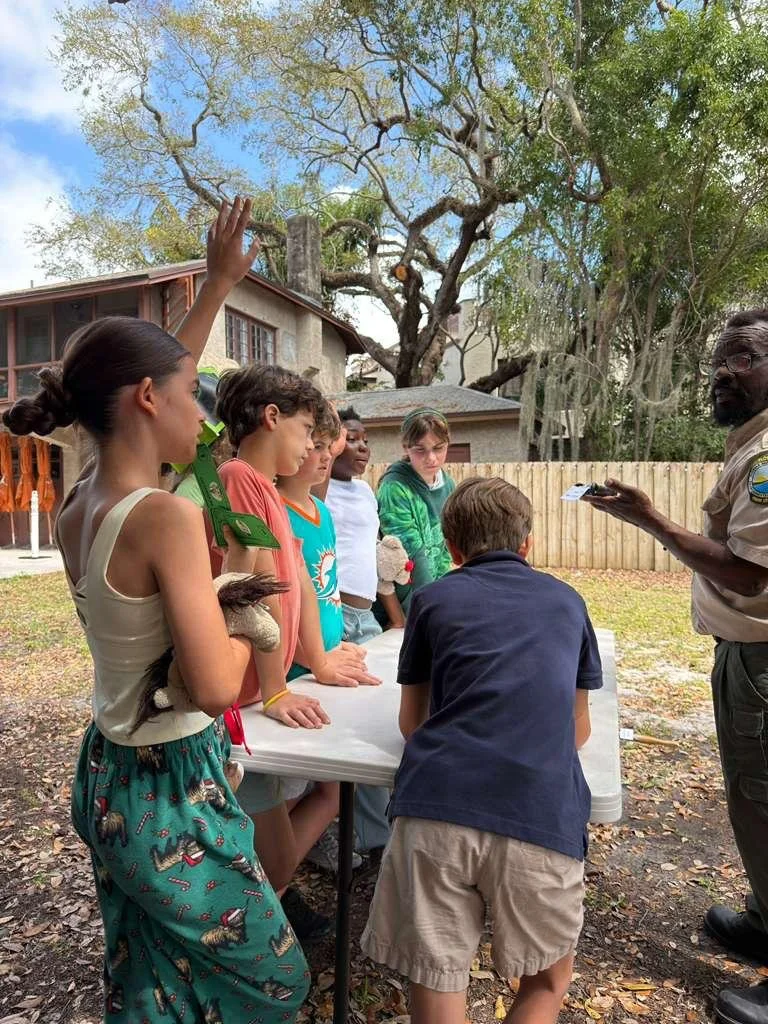
A junior ranger raises her hand to answer Ranger Kevin Floyd’s question
Washington Birthday Regatta — 30th Edition
by Olivier de Lavalette
On February 21st, 2026, Biscayne Bay once again played host to the Washington Birthday Regatta — and what a day it was. The 30th edition set a record with 19 registered boats across four classes: Egret, Plover, Sandpiper, and the newly introduced Mail Run class. The wind filled in beautifully around noon for three well-paced races, and the day rounded off with the beloved post-race Chowder Party, drawing at least 70 participants to the Coconut Grove Sailing Club (CGSC).
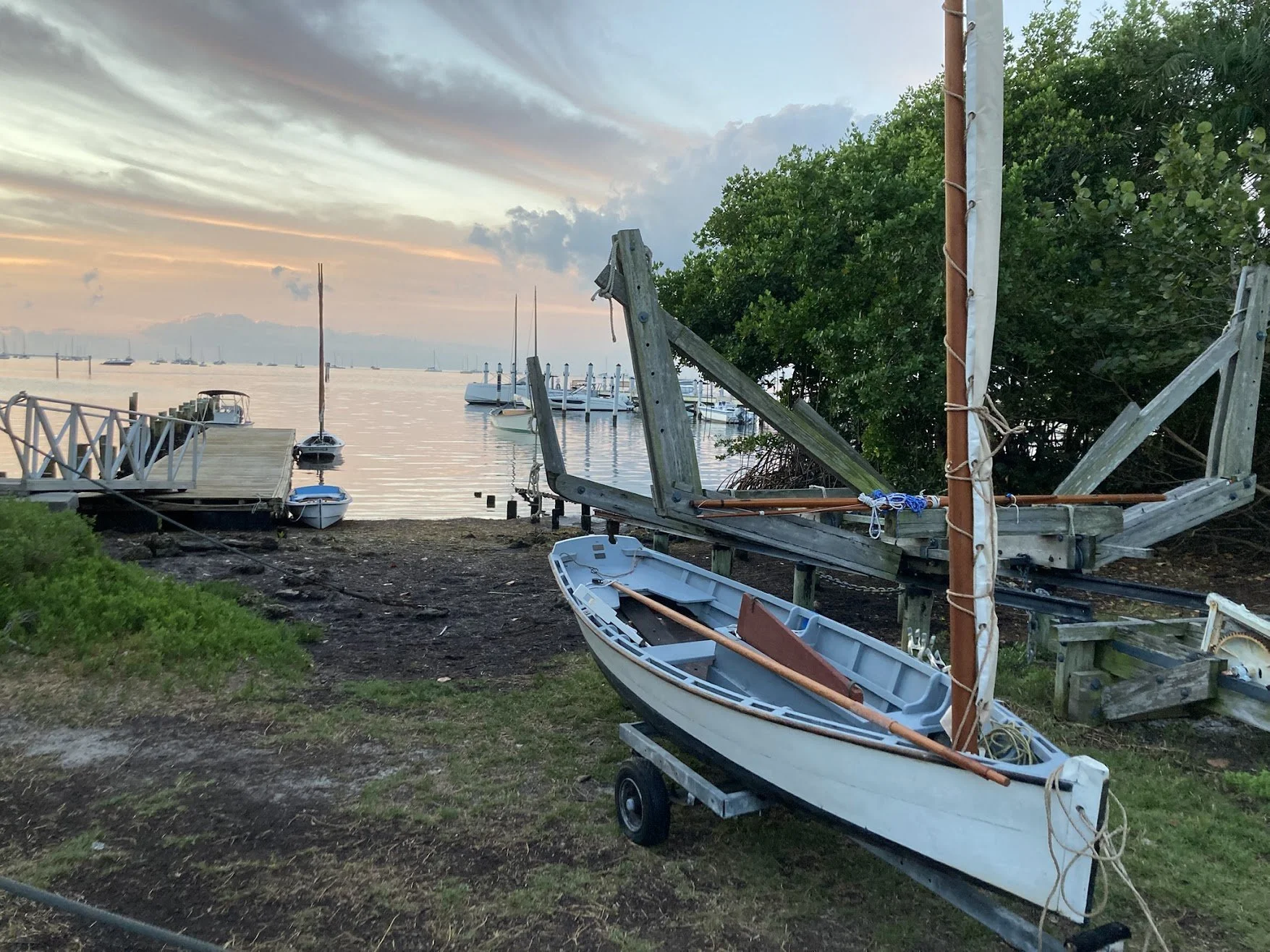
Morning breaks over the boats at the shore of The Barnacle
The morning opened at Barnacle State Park with the Skippers' Meeting, where volunteers welcomed everyone to a communal potluck breakfast. True to tradition, many arrived in early 20th-century costumes, turning back the clock to 1887 — the year the WBR first set sail. Under the expert guidance of CGSC Regatta Chair Steve Herman, race instructions were delivered with the dual emphasis that defines this event: safety and good spirits. A special moment of recognition went to Jack Fell, our longest participating skipper, who was present at the very first edition back in 1996. His faithfulness to the event is a reminder of what keeps us coming back — there may well be truth to the old adage: "A day on the water is not deducted from your days of life."
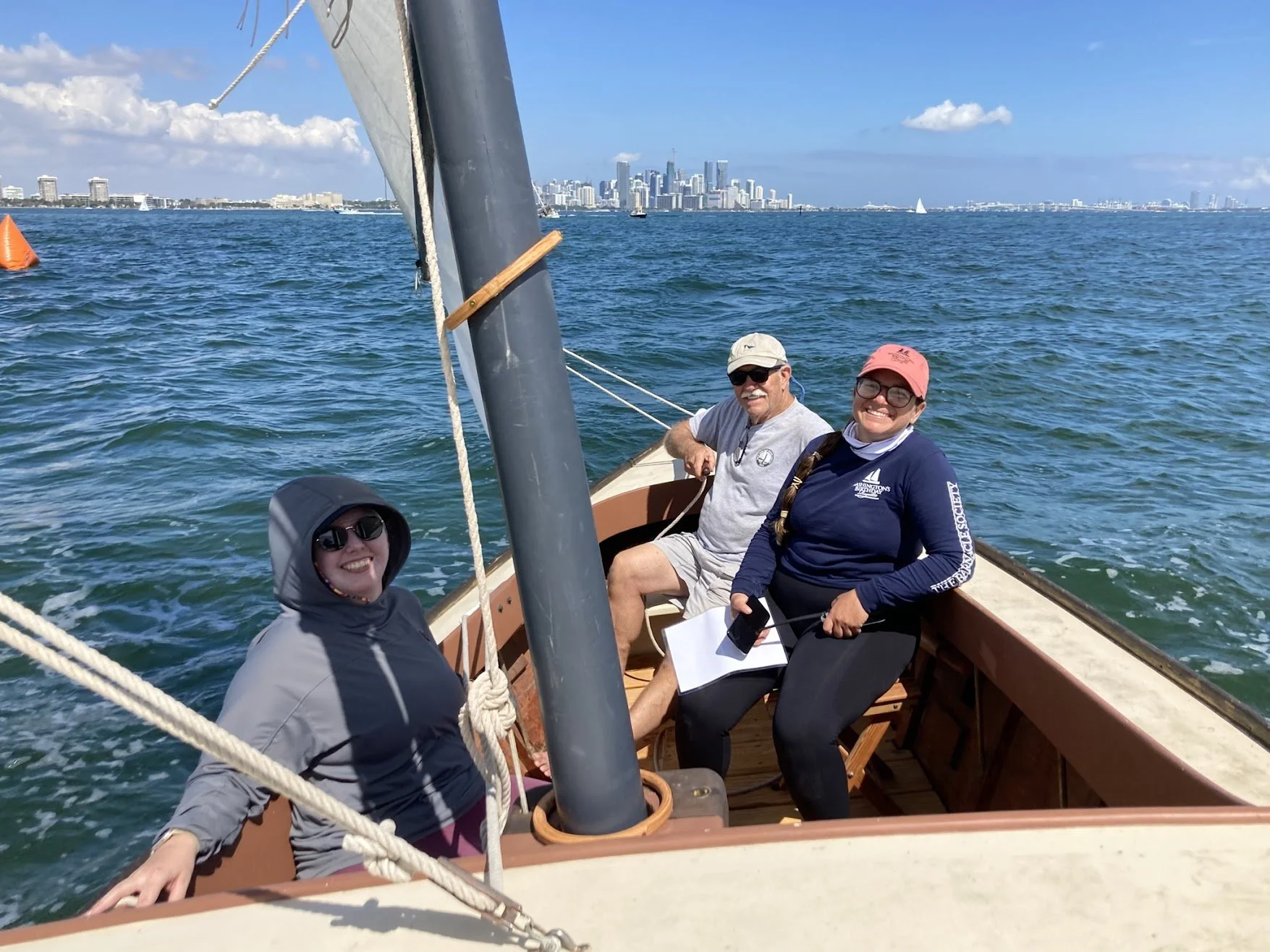
Mike Chapman sailed Egret with crew Gabi Bello Ugalde (right), Shelby Hoogland (left), and Mike Rosenbaum (behind the camera)
And then the race was on! Skippers cast off from the generously loaned floating dock and CGSC's mooring balls, and from the first gun, the racing was tight. The spirits were high and the conditions just about perfect. Richard Crisler — a Hall of Fame US Sailing instructor and longtime WBR participant — swept the Egret class, taking first place in all three races. Needless to say, he was quite pleased with himself, and rightfully so; the man is still very much a competitor. Other classes were more hotly contested. Rumor has it that at least one Mail Run boat may have taken a wrong turn on course — probably for the best, given that they are no longer carrying actual mail, as Commodore Munroe once did in these very waters.
By late afternoon, all sailors were safely ashore, and the gathering moved next door to CGSC for the traditional Chowder Party. For the second consecutive year, CGSC generously opened its doors, providing full support for the celebration — a testament to the deep and enduring friendship between the two organizations. The setting could not have been more fitting: the sun dipping over the mooring field, the friendly retelling of the day's races and races long past, photos making the rounds, the easy laughter of the staff, and — let's not overlook the star of the table — Chef André's famous clam chowder. The Big Room became something more than a party venue. The warmth in that space was unmistakable: care, camaraderie, and genuine community. Simply the best.
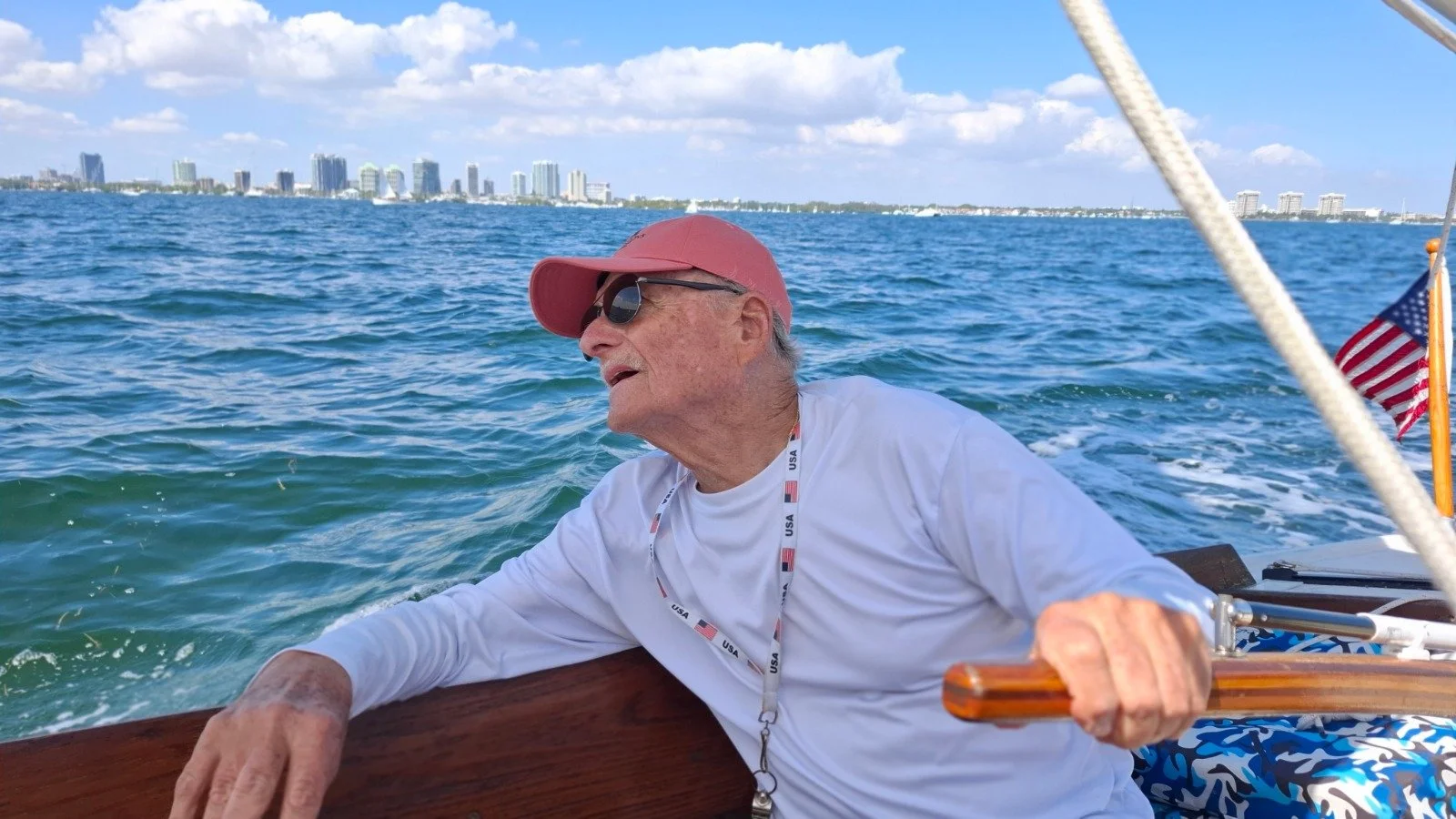
Richard Crisler swept the Egret class in “Butterfly”
As the evening drew on, it was time to honor the day's winners — and more meaningfully, to announce the second recipient of the annual Renny Young Service Award, given for outstanding and longstanding contributions to our community (Renny was the first recipient, posthumously). This year's honoree was none other than Richard Crisler, who celebrated his 87th birthday this year and who also took home the costume contest. In his own words: "This was one of the most significant and humbling events of my senior life. I will be able to enjoy this for years through memories and pictures." Richard, the entire Barnacle Family wishes you many more mornings on the bay.
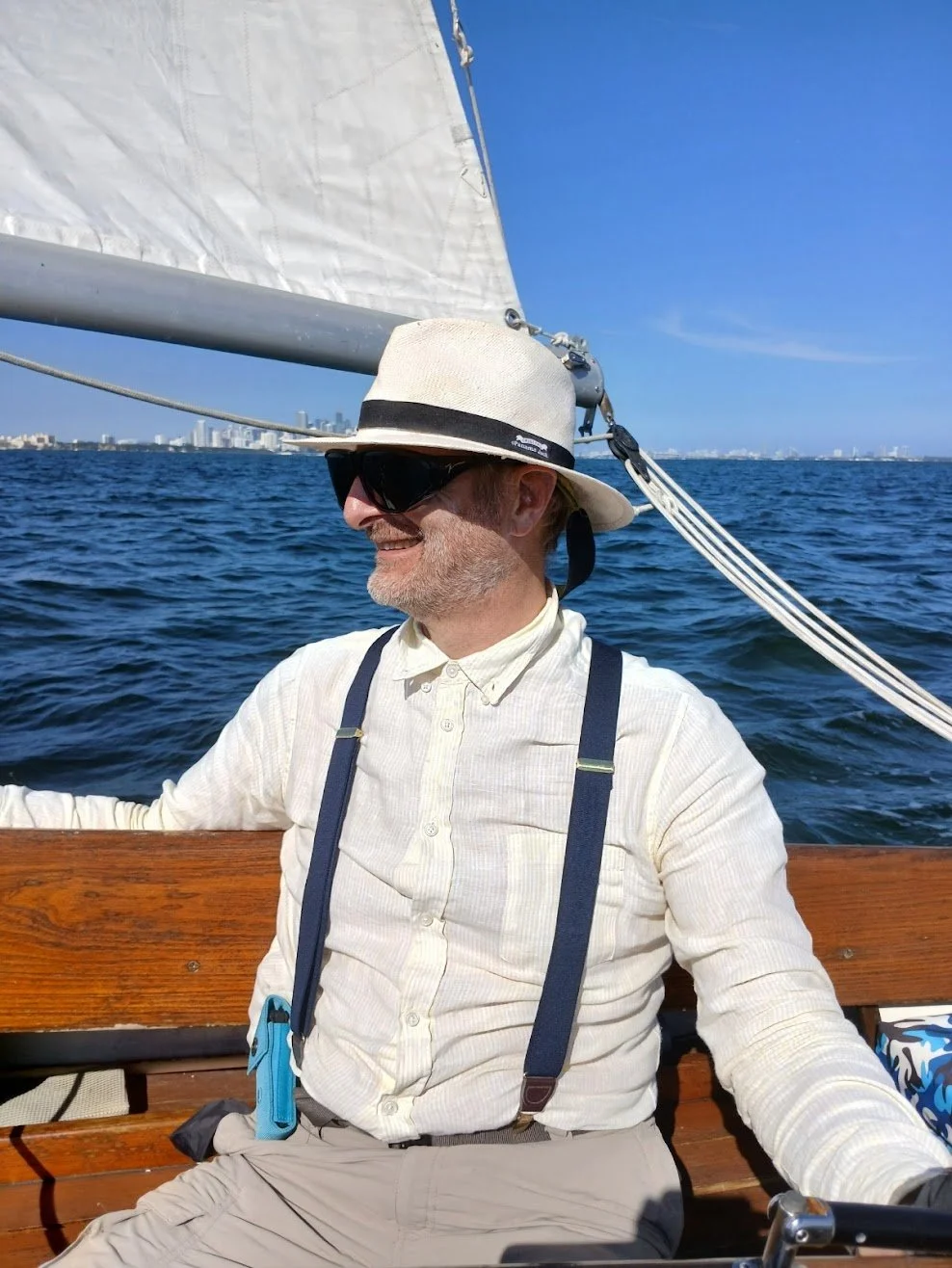
Olivier de Lavalette sailed with Richard Crisler and wrote this article!
No account of this day would be complete without a heartfelt tip of the specially designed Nantucket Red 30th anniversary cap to John Palenchar and Amy Exum, whose steady and gracious leadership as event chair and vice-chair brought it all together. And to every volunteer who made it happen — Tom and the beautiful Belle Noire (our signal boat), Suzanne (the force supporting John), Steve (Race Officer), Dan (Park Manager) and the park staff, Alyn, Thomas, Bob, Glen of Dock and Marine Construction (our floating dock), Joe, Graham, and Walt on safety boats, Olivier, Cheryl, Skip, Danny, Wendy, Mel, Gabi, André, the Barnacle Society Board, and every unsung volunteer working quietly behind the scenes — thank you. This simply would not have happened without you.
I'm already looking forward to next year. Until then, may the winds be gentle and fair to all.
Kind regards,
Olivier
Sawdust and Shavings
by John Palenchar
The Barnacle Boathouse continues to buzz with activity as various “projects” are introduced—either by “request” or by “choice.”
Requests:
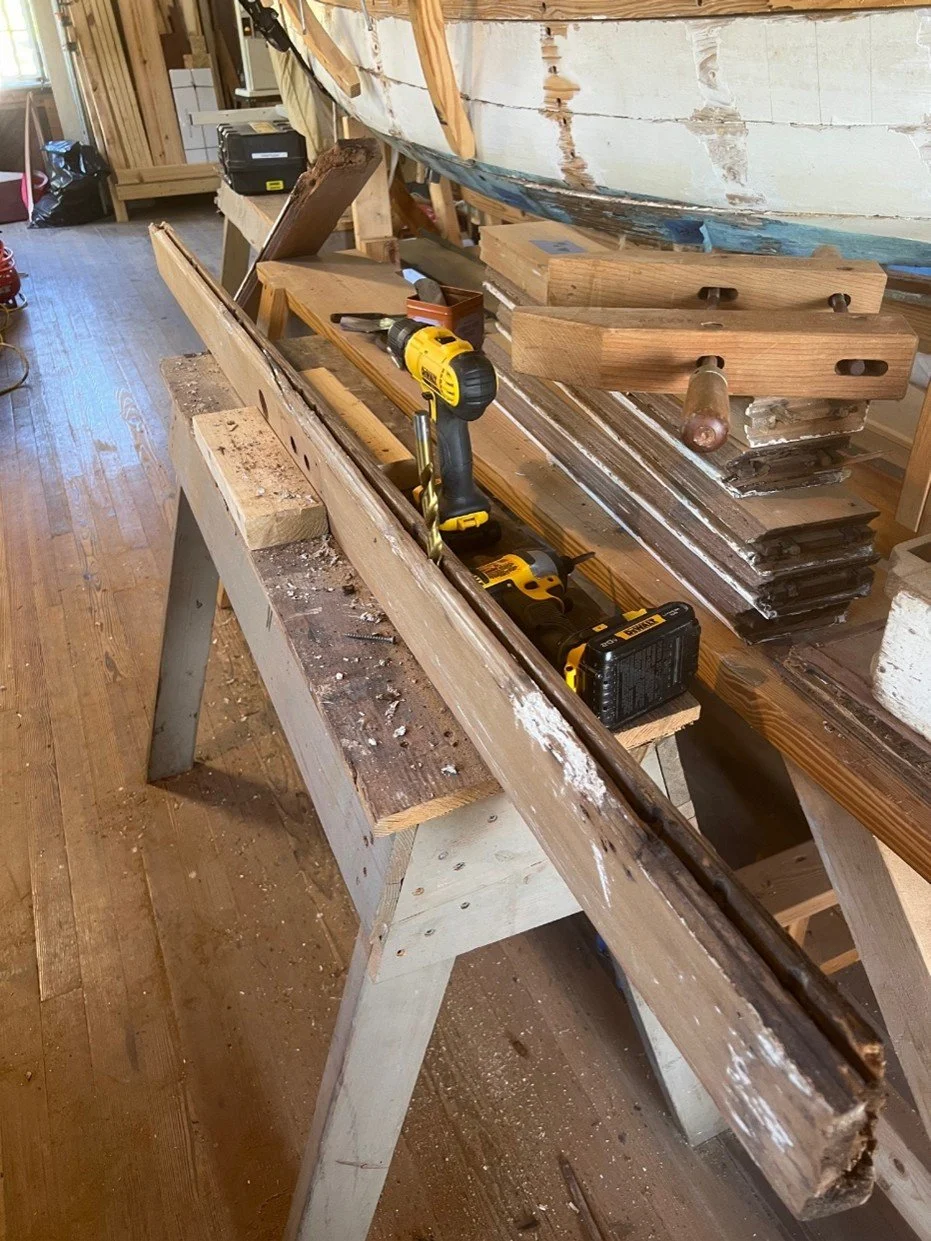
Disassembled Jelly Room Door. Note rot in the bottom of the stile.
Jelly Room Door. Mike Chapman’s excellent workmanship in crafting a new side door for the boathouse has led to another “door” project. This time it’s fixing the deteriorating door of the Carriage House (Park Office) Jelly Room (laundry). Mike has completed disassembly and is now in the process of stripping and sanding all the pieces. His plan is to replace the 5 plywood panels and to replace the “bad” wood in the lower part of the door.
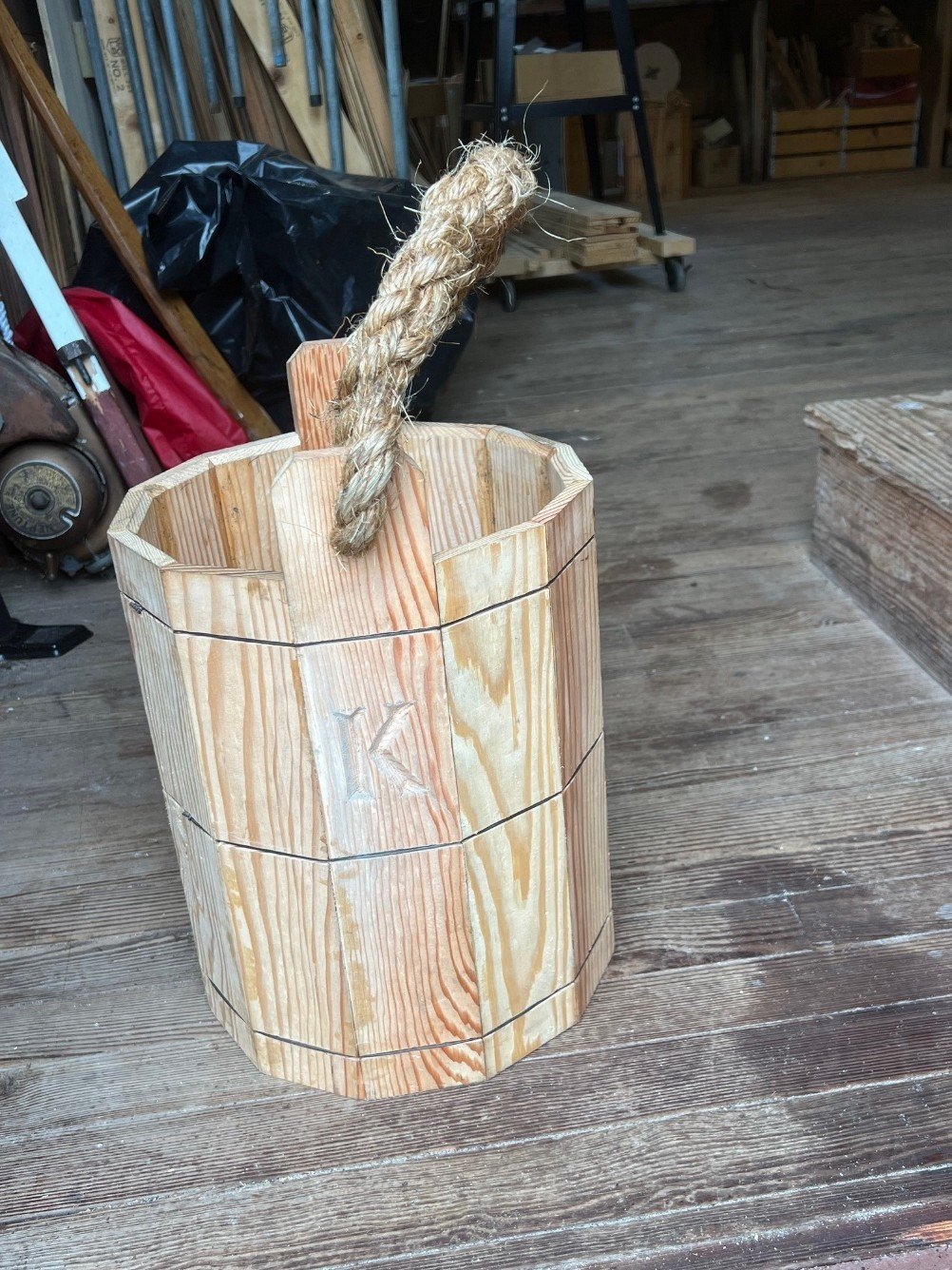
Volunteer Peter Jelonek’s “Kampong Bucket”.
Barnacle Buckets. A few years back, the decision was made to replace the 5-gallon plastic trash buckets in the Boathouse with more “era-appropriate” wooden ones—hence, the Mike Chapman designed “Barnacle Bucket.” Now comes the request from our “historic” sister institution down the street, The Kampong (home of renowned plant explorer David Fairchild and his wife, Marian (daughter of Alexander Graham Bell). A new interpretive initiative featuring the office of Dr. Eleanor Galt-Simmons (an earlier resident of the property) has led to a similar need to replace those ubiquitous 5-gallon plastic buckets and a request for some of our wooden ones. Three buckets were requested and production is almost complete!
Display Stand. A request from our wonderful Museum Registrar, Vinny Nastasi (see article introducing Vinny elsewhere in this newsletter), led to the building of a display stand for the Barnacle library. What was fun and interesting was that Vinny suggested we use part of an old mast hanging from the roof beams of the Boathouse. The mast had a “repair” in it, which is interesting in itself , as it is an example of a repair method used on wooden masts in days gone by. The “splice” is now the vertical component of the stand and incorporates another interpretive element as well as the sextant which sits on it!
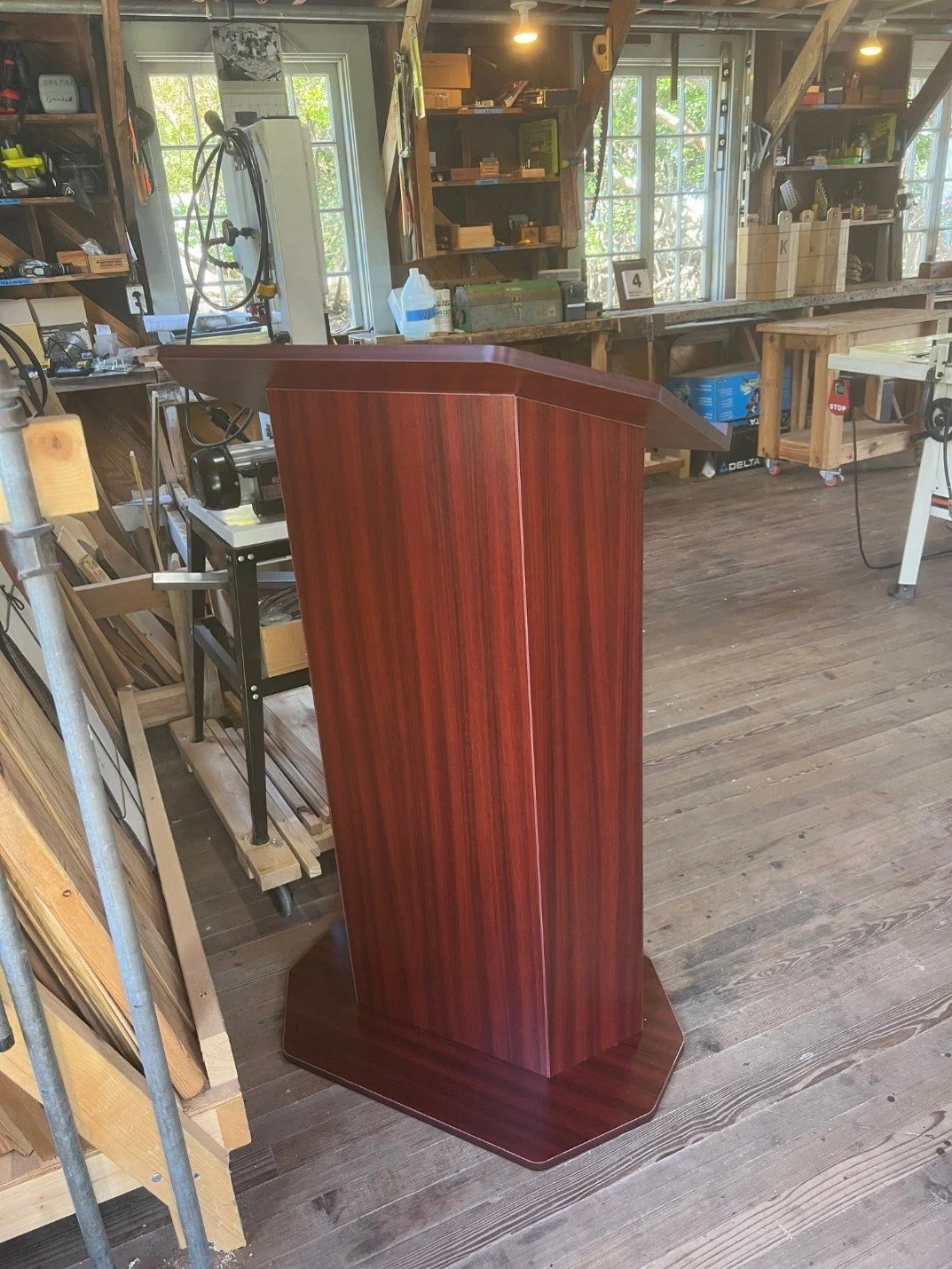
Podium assembled and ready for Poetry Night at The Barnacle
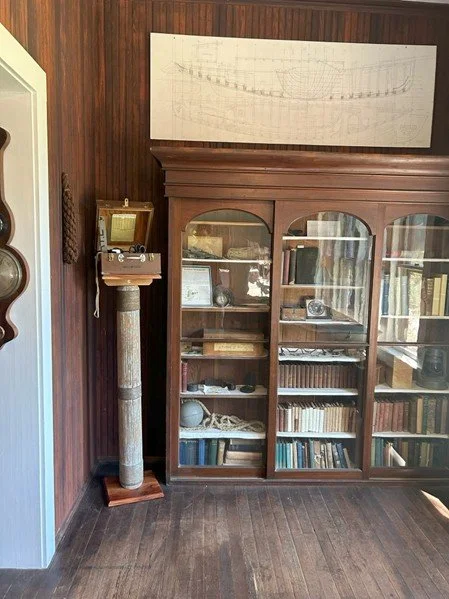
Sextant Display stand using a piece of damage wooden mast encased in strips of wood and bound with wire rope.
Poetry Night Podium. Last week a shipping crate appeared in the Boathouse with an “assembly” request—the new podium for our upcoming Poetry Night (don’t miss it!). My visiting daughter, Chloe and her wife, Linda volunteered and, voila!—the podium is assembled and ready to go.
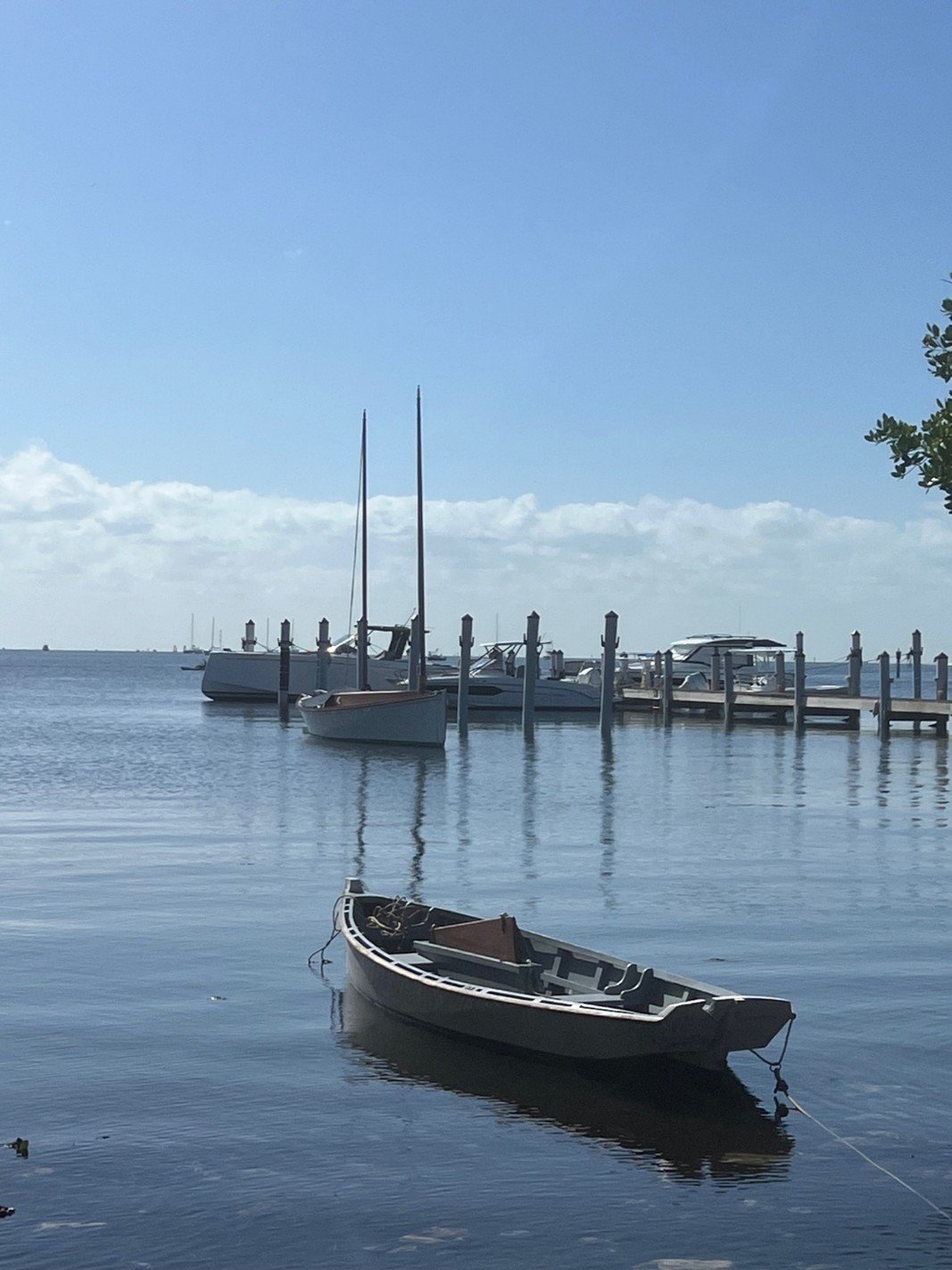
Caulked and afloat, “Sparrow” looks ready to sail!
Project of “Choice”:
Cape Sable Sparrow. Our Boathouse-built flat-iron skiff (inspiration for all “sharpie” designs) was in need of some TLC and Peter Jelonek took up the challenge. A coat of “Salty Dog” on her floorboards and a coat of Pine Tar on her bottom failed to keep her from sinking at the dock on the day of our Washington’s Birthday Regatta. Undaunted, Peter caulked her largest leaks and is currently updating her rigging with a little-used “traditional” reefing system using a “brailing line.”
Sailing Into the Past with the Flying Proa II
By Inquisitive Ranger Shelby Hoogland
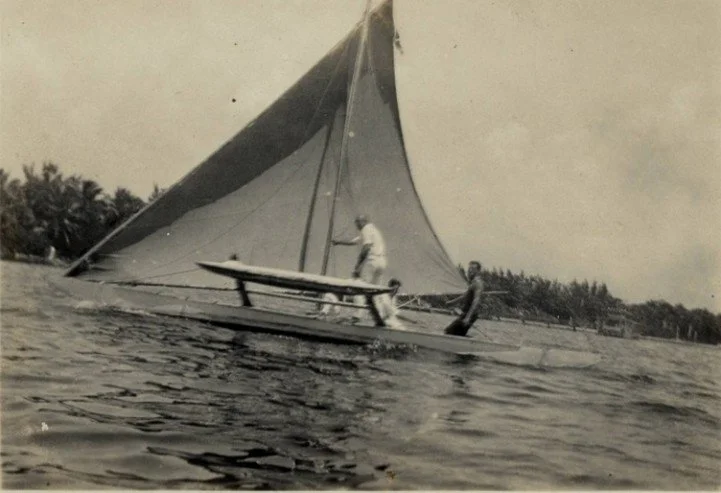
Figure 1. One of Ralph Munroe's proas. Notice how the arm, the aka, serves as a counterweight to the wind on the sail. Photo courtesy of the University of Miami Richter Library, Ralph M. Munroe Family Papers Collection.
On a breezy winter morning, John Palenchar, Vincent Nastasi, and I sat down with Dr. John van Leer to talk about reconstructing the Flying Proa for the centennial anniversary in 1998. In the old pavilion, if you had looked up you might have noticed a white boat stored in the rafters. Today, in the absence of the pavilion, it is now sitting next to our stone wall. This is our Flying Proa II, a replica of the original made by Ralph Munroe in 1898. To understand the process of building a replica of Ralph’s most unique vessel, we must first understand why a proa is so unique.
What is a Proa?
A proa is a type of vessel that is common in Austronesian sailing and is characterized by having multiple hulls. As Polynesians started their initial migration out into the vast Pacific Ocean from about 1500 BC, the proa and other multihulled boats like catamarans and trimarans were integral in moving these seafaring people across the western Pacific and Indian Oceans (Mahdi, 2012). Over the millennia, each Polynesian island group modified the proa to meet their specific needs.
Ralph’s Inspiration
Captain Nathanael Herreshoff, a world-renowned yacht designer and sailor, formed a friendship with Ralph Munroe and with Coconut Grove, resulting in multiple extended winter visits. Herreshoff is considered the first person in North America known to have built a sailing catamaran, which he named Amaryllis. Ralph was inspired by the speed of a Malay proa brought to Biscayne Bay as deck cargo on a steamer and would build four versions of the Flying Proa. Munroe and Robert Barnwell Roosevelt (Theodore Roosevelt’s uncle) would build some of the first proas in North America (O’Donnell, 2009). Today, many sailboats attempting to set speed records are based on proas. Munroe published his original proa design in Rudder Magazine in 1898. In this publication he provides a vivid image of what sailing a proa is like.
“Sailing is no name for it - flying is better. Out into the bay she skipped, boys yelling with delight on the uplifted outrigger, spray from the lee bow and steering oar riven into vapor by the speed blowing to leeward. It was grand!” (O’Donnell, 2009).
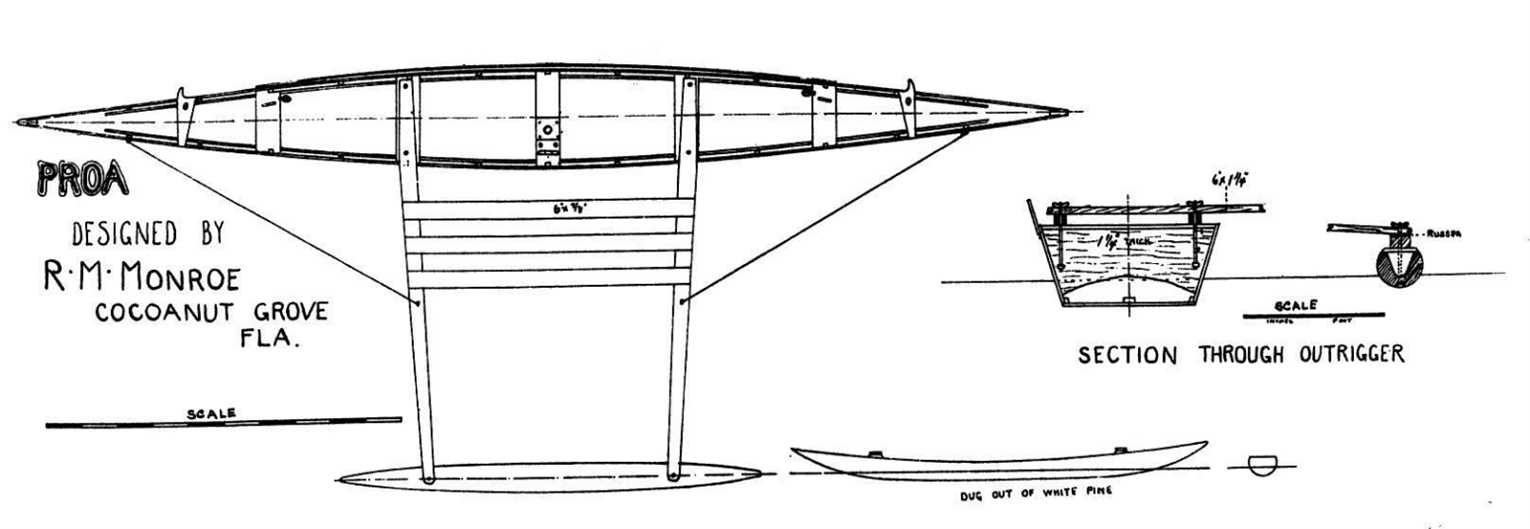
Figure 2. Ralph Munroe's 1898 design of the Flying Proa (O'Donnell, 2009).
How does it sail? Watch a Marshall Island proa in action.
The main hull, or the vaka, of the proa that Ralph would build was symmetrical from end to end, allowing it to be sailed in either direction. The outrigger, or the ama, acts as a counterweight to windward. To change direction of sailing, a normal vessel would typically “come about” by shifting the wind to the opposite side of the bow. To make progress upwind, a typical vessel must tack, following a zigzag path toward the wind. However, Ralph would build a proa that uses ‘shunting’ to change tacks (direction). This means that to turn, one would need to pick up the sail from the bow and move it back towards the stern while simultaneously moving the steering oar to the opposite end and interchanging the two daggerboards (like a centerboard). Thus, the bow becomes the stern, and the stern becomes the bow. Scan the QR code to see a proa’ immense speed. In this video, you’ll also notice how closely Ralph’s design resembles the typical Marshall Island proa design.
Vincent Gilpin, a close friend of Munroe and a fellow sailor, wrote in his book, “The Cruise of the Seminole” (Gilpin, 1905), what sailing the Flying Proa was like:
“We slid quietly to leeward with a mere zephyr, the outrigger trailing idly in the water, our heads craned backward looking for a breeze. Then came a little puff, and we gasped as the outrigger lifted, and the proa leaped like a horse under the lash. It lasted only a few seconds, and then again we drifted quietly away almost becalmed.
Then it came, roaring over the pines, and smiting the startled water into a tumble of frosted silver. The proa, outrigger lifted, sail bellying high in the air, rose as a duck taking wing – rose bodily several inches and lo! Where there had been familiar tossing waves, suddenly there was a mere foam-streaked blur of vague gray-green, whirling madly past. Sanford on the outrigger wore a dazzled grimace of ecstasy. The Commodore [Ralph Munroe] tugged with all his might at the buckling steering oar, which cut an open cleft in the water several feet long, one side of the blade being visible down to the tip. Spray from the cutwater pelted us like shot, and that amazing green torrent rushed frantically by beneath us.”
The Building of Flying Proa II
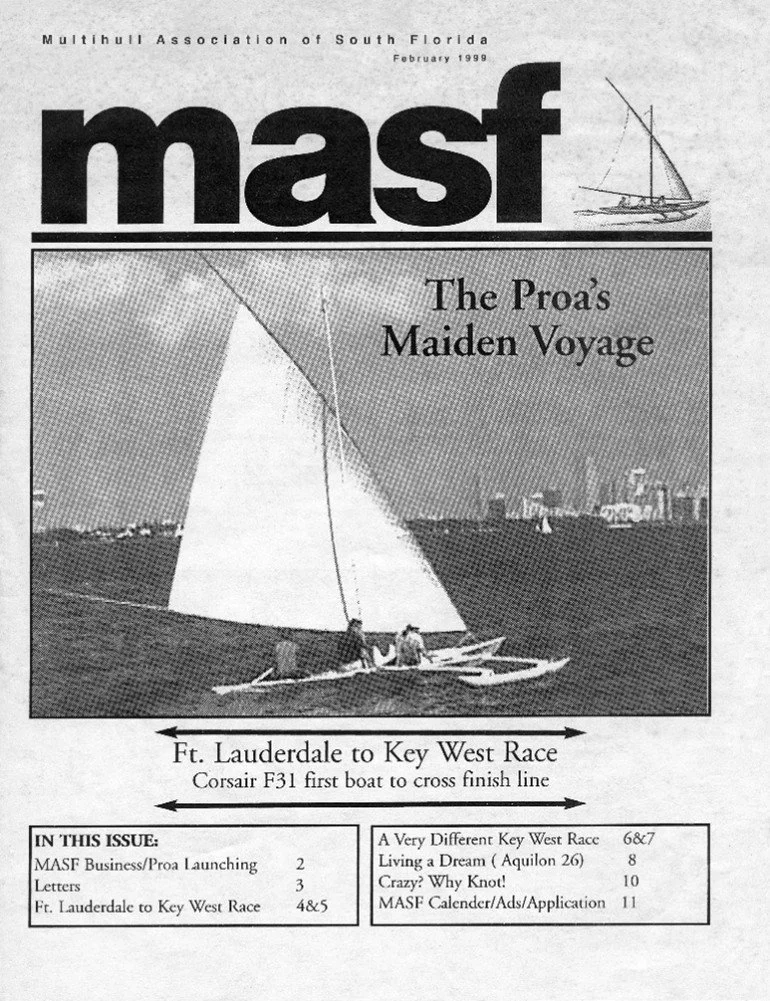
Figure 3. Cover page of the Multi-Hull Association of South Florida Newsletter (February 1999). The photo is of the Flying Proa II in action for the first time being sailed by Dr. John Van Leer, Sam Van Leer, and Dennis Finkman. Photo courtesy of Dr. John Van Leer.
In 1998, Dr. John Van Leer, his son Sam, and 30 other Multihull Association of Southern Florida (MASF) volunteers began construction on a replica of Ralph’s proa design. The first task was to find the design and adapt the plans, so it could be built with what is available. Van Leer describes how a weeklong boat-building course held by the Wooden Boat organization in the Micco Pavilion provided the inspiration and confidence to undertake this endeavor.
The strong back sections were lowered from the second-story window of the boathouse to volunteers on the ground. Construction moved to the Micco Pavilion, where the main hull was completed. The original proa design used 30’ oak planks, but as Van Leer jokes, “you could only find those nowadays in Alaska.” They instead used 3/8” marine plywood with scarf joints to join the 12’ sheets. In a non-carpenter’s words, they would take two very thin pieces of wood, cut them at a very fine angle, and glue them together. This required incredible precision.
While their end goal to launch the Flying Proa II was the centennial anniversary of when Ralph first built a proa in 1898, they did not finish until 1999. I would be remiss to not mention Tom Mestrits, an integral volunteer builder who worked on both the amas – the arms that connected the main hull to the outrigger,and the akas, as well as contributed much time during the fiberglass phase.
The final component of any sailing vessel is the sail itself. This particular sail is what’s known as a crab-claw sail. It is triangular in shape, and two sides of the triangle are connected to spars – long wooden beams that help give the sail its shape. The sail is attached to the main mast with a halyard – a line (rope) used to hoist the sail. The shape and attachment of the sail creates lift and an attached wind vortex from the trailing end of both spars. C.A. Marchaj designed wind tunnel experiments that showed that the crab-claw sail is in fact the most efficient sail (Marchaj, 1964). What’s more, the delta wing created for fighter jets interacts very similarly with wind and lift as a crab-claw sail.
On February 7th, 1999, a ceremony held at The Barnacle launched the new Flying Proa II. Former Park Manager Terry Coulliete, Bill and Irene Munroe, and Dr. John Van Leer spearheaded its initiation. After a talk given by Bill Munroe on his grandfather Ralph Munroe’s enormous contributions to the sailing community, Irene Munroe christened the vessel with the traditional champagne pour over the bow. When describing what it was like sailing the Flying Proa II for the first time, Van Leer described it as a “great relief.”
Author acknowledgments: Appreciation is due to Don Seidler, Sam Van Leer, Tom Mestrits, Eric Tullberg, Dennis Finkhouse, John Gregory, Shell Lumber, West Marine, Bremen and Sons, and Consolidated Yachts for their time given and contributions to the building of the Flying Proa II.
Resources
Oral Interview with Van Leer, John, Feb. 9, 2026
Books
Gilpin, Vincent. The Cruise of the Seminole among the Florida Keys, March 10-April 5, 1905. West Chester, Penn.: n.p., 1905. Reprinted by the Museum of South Florida History, 2000.
Marchaj, C. A. (1964). Sailing Theory and Practice.
Online Sources
Admin. (2019, February 23). The Rudder Magazine Online (1922) - Classic Sailboats. Classic Sailboats. https://classicsailboats.org/the-rudder-magazine-1922/
Mahdi, W. (2012). The dispersal of Austronesian boat forms in the Indian Ocean. Archaeology and Language III, 162–197. https://doi.org/10.4324/9780203202906-16
O’Donnell, C. (2009, December). American Proas, 1898 - 1998. Cheap Pages/American Proas 1898-1998. http://www.thecheappages.com/proa/commodore.html#Mary%20&%20Lamb
Nathanael Herreshoff - Herreshoff Marine Museum. (2021, July). Herreshoff Marine Museum. https://herreshoff.org/inductees/nathanael-herreshoff/
Are you interested in sailing and have carpentry experience?
Volunteer in our historical boathouse and contribute to the conservation of this vessel and more! Contact Kevin Floyd at Kevin.Floyd@FloridaDEP.gov for more information.
Renew your membership
The support of our community helps ensure the future of The Barnacle. Your membership makes a huge impact in the maintenance of the museum, the grounds, and all the amazing projects in the Boathouse. Please take a moment to renew your membership, or to become a member if you have not done so already. Thank you for supporting The Barnacle!
Meet the Locals – getting to know native plants at the Barnacle
By Shelby Hoogland
Coming from a background in science and in nature, history has not always been my top priority. Do I enjoy slow perusals through museums reading every label (much to my partner’s dismay)? Absolutely. But it wasn’t until I discovered the Barnacle that I realized the future is at the intersection of history and traditional ecological knowledge. How indigenous peoples experienced their natural environment 100 years ago can teach us to be more fully in tune with ourselves and the future we’d like to see.
The idea of a naturalist has evolved over many years. Originally, anyone (but mostly wealthy white men) with a zest for life, and the willpower to trek through difficult environments, could look out into expansive valleys and tall peaks, write some words about it, and then they were considered a naturalist. In contrast, a modern naturalist needs training, formal education, experience, references, and finally, the willpower to slog through the noise of our current world to show how incredible a simple tree like the gumbo limbo can be. I’d like to take us back to the idea that anyone with enough curiosity can be a naturalist in some way. However, I have one caveat: to be a naturalist it is not enough to know – a true naturalist is also a protector and a steward of that which they educate about.
The Seminoles, though not originally natives of Florida, were forced to quickly become acquainted with their new home in the Everglades. Through a series of unfortunate events (ie. the three Seminole Wars where they fought for their freedom), the Seminoles found themselves in a wet and buggy land full of snakes, alligators, and crocodiles. But through being forced to survive in a new environment, they found a way to make it work and worked with the land in a way that hadn’t been seen since the time of the Calusas and the Tequestas.
The Barnacle is full of wonderful native plants. Native plants are regarded for not just their benefits to local fauna, but also for their ability to protect and heal. Below are some examples of native plants found at the Barnacle that have real life uses.
1. White Stopper, Eugenia axillaris
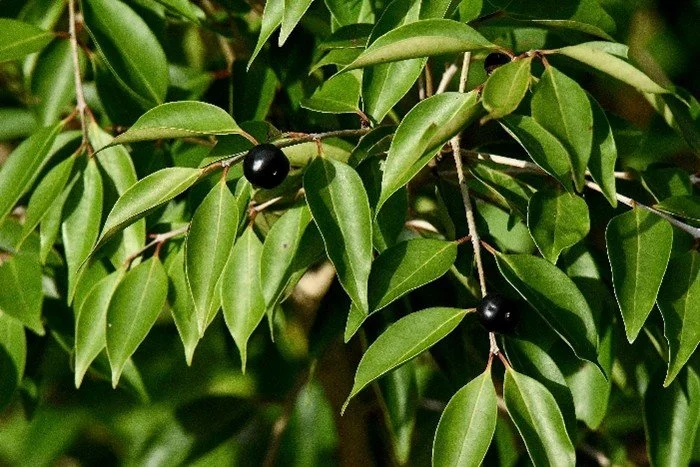
White stopper courtesy of wildsouthflorida.com
White stopper is native to Florida as well as Bermuda, the Caribbean and Central America. The plant contains 42 volatile compounds of musty and earthy smells, which has often been described as “skunk-like”. Some people believe that this plant was used to stop diarrhea while others believe that its dense foliage “stops” people from walking past it.
2. Poison Wood and Gumbo Limbo
Poisonwood (Metopium toxiferum) is in the Anacardiaceae, the same family as mangos and poison ivy. These plants all produce urushiol – a substance that causes an oozing, itching rash. Rubbing against the leaves or bark can cause reactions in allergic individuals. If you are able to clean off the area (using a poison ivy cleaner like Tecnu, or gumbo limbo leaves, see below) a reaction may be avoided. One can even be “poisoned” by standing underneath the tree when raining.
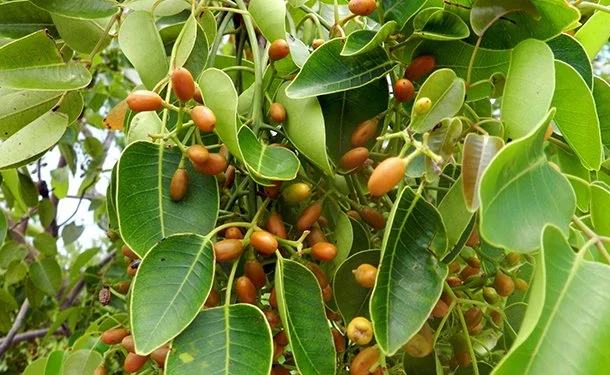
Poisonwood closeup c/o Tree Care Guide
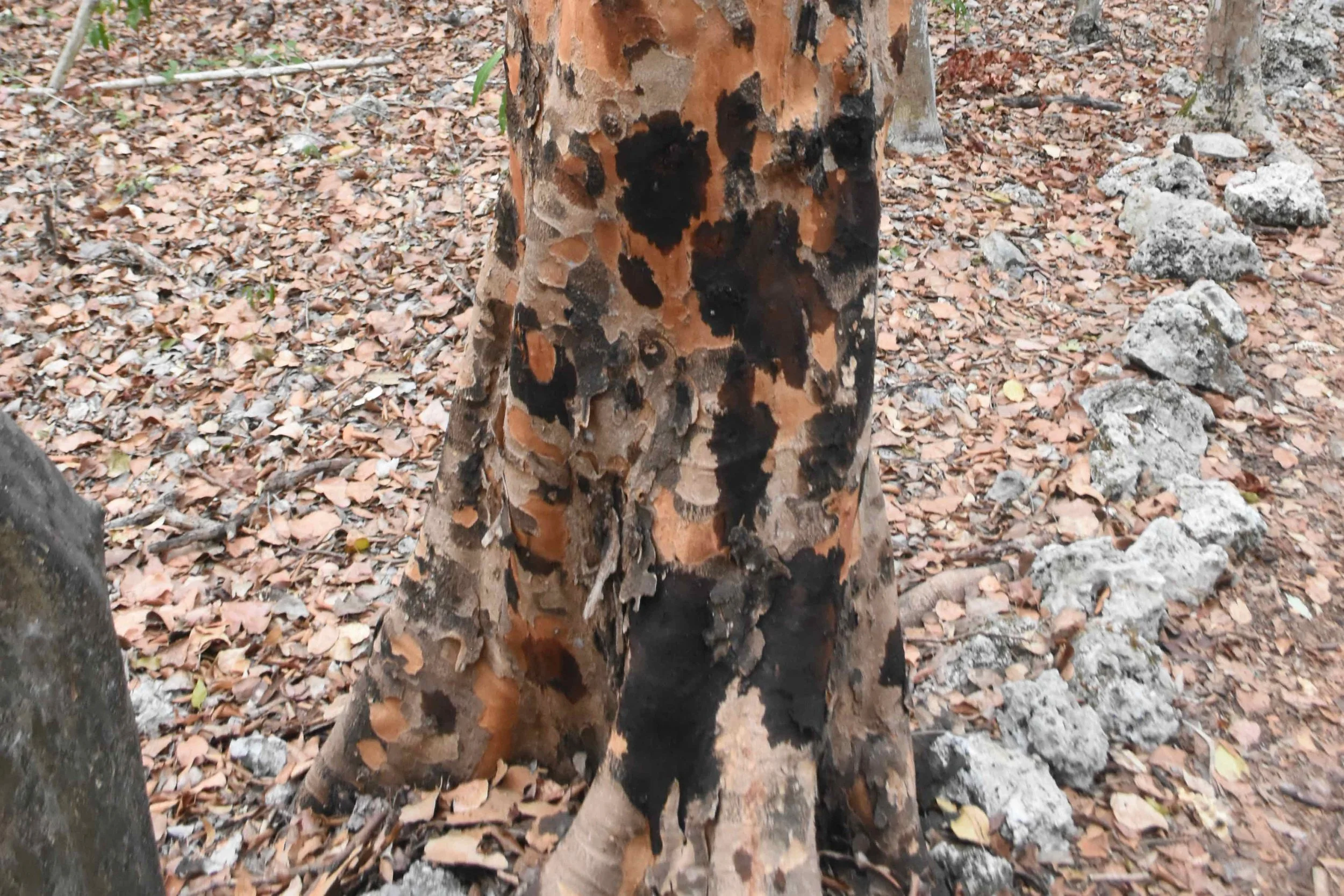
Poisonwood trunk - the black areas are especially toxic! Image from Wild South Florida.
Gumbo Limbo (Bursera simaruba) is a visually distinct tree that once you learn what it looks like, it’s hard to not see it just about everywhere you go in South Florida. Often called the “Tourist Tree” as the bark is red and peeling like how a tourist might leave their Florida vacation. By making a paste out of the bark, it can treat the effects of the poisonwood, as well as treat psoriasis, eczema, and insect bites. The fresh leaves can be crushed and rubbed on skin exposed to poisonwood, cleaning the toxin away (useful when walking around in the woods!).
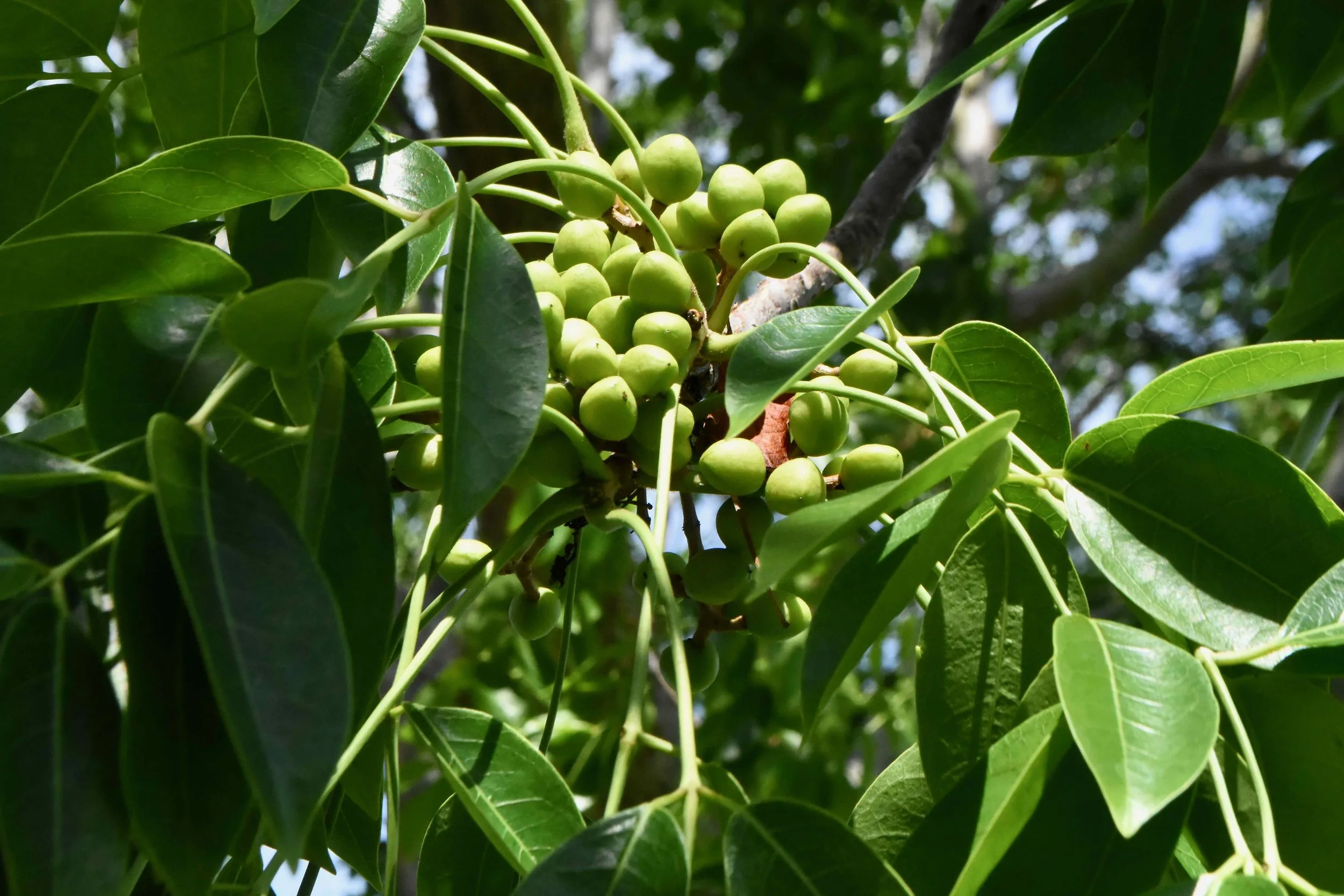
Gumbo limbo leaves and fruit on a female tree. Image c/o Wild South Florida.
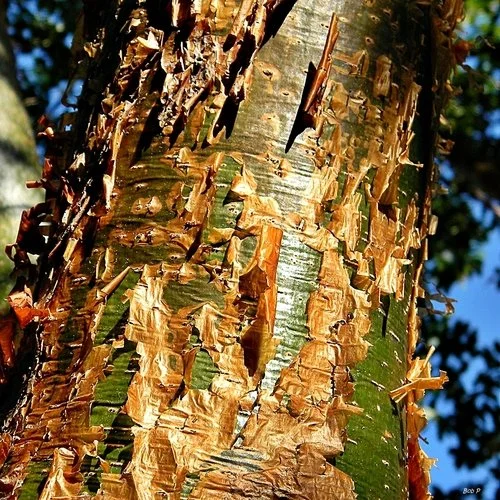
Peeling bark on gumbo limbo tree - image from SPC Florida Plants (I-naturalist)
ABOUT THIS NEWSLETTER
The News Packet was created to inform members and public about The Barnacle Society, The Barnacle Historic State Park, and events and activities there. Published quarterly by The Barnacle Society, it is part of our continuing program to support and preserve the home of Commodore Ralph Middleton Munroe. The News Packet represents the method of mail and news delivery before the turn of the 20th century. A small boat sailed to Fowey Rocks Light and received a “packet” of newspapers and mail from passing coastal ships bound for Key West or Jacksonville.
Suzanne Koptur, Editor
Gabi Bello, Webmaster
BOARD MEMBERS
Officers
Mary Scott Russell, President
Sweet Pea Ellman, 1st VP
Kevin Black, 2nd VP
Graham Coords, 3rd VP
Rafael Felippe, Treasurer
Debra Wellins, Recording Secretary
John Palenchar, Corresponding Secretary
Directors
Peter Berman, Ashley Castillo, Bryn Ingram, Olivier de Lavalette, Wirth Munroe, Doug Reno, Marc Stone, Pam Shlachtman, Walt Walkington
MISSION STATEMENT
The Barnacle Society, Inc. is a volunteer non-profit, citizen-supported organization created to generate public awareness, education, and financial support for the preservation and maintenance of The Barnacle Historic State Park.
PARK HOURS
Thursday through Monday 9 AM to 5 PM Closed Tuesdays and Wednesdays, New Year's Day, Thanksgiving, and Christmas.